Get the Right Mortgage for you!

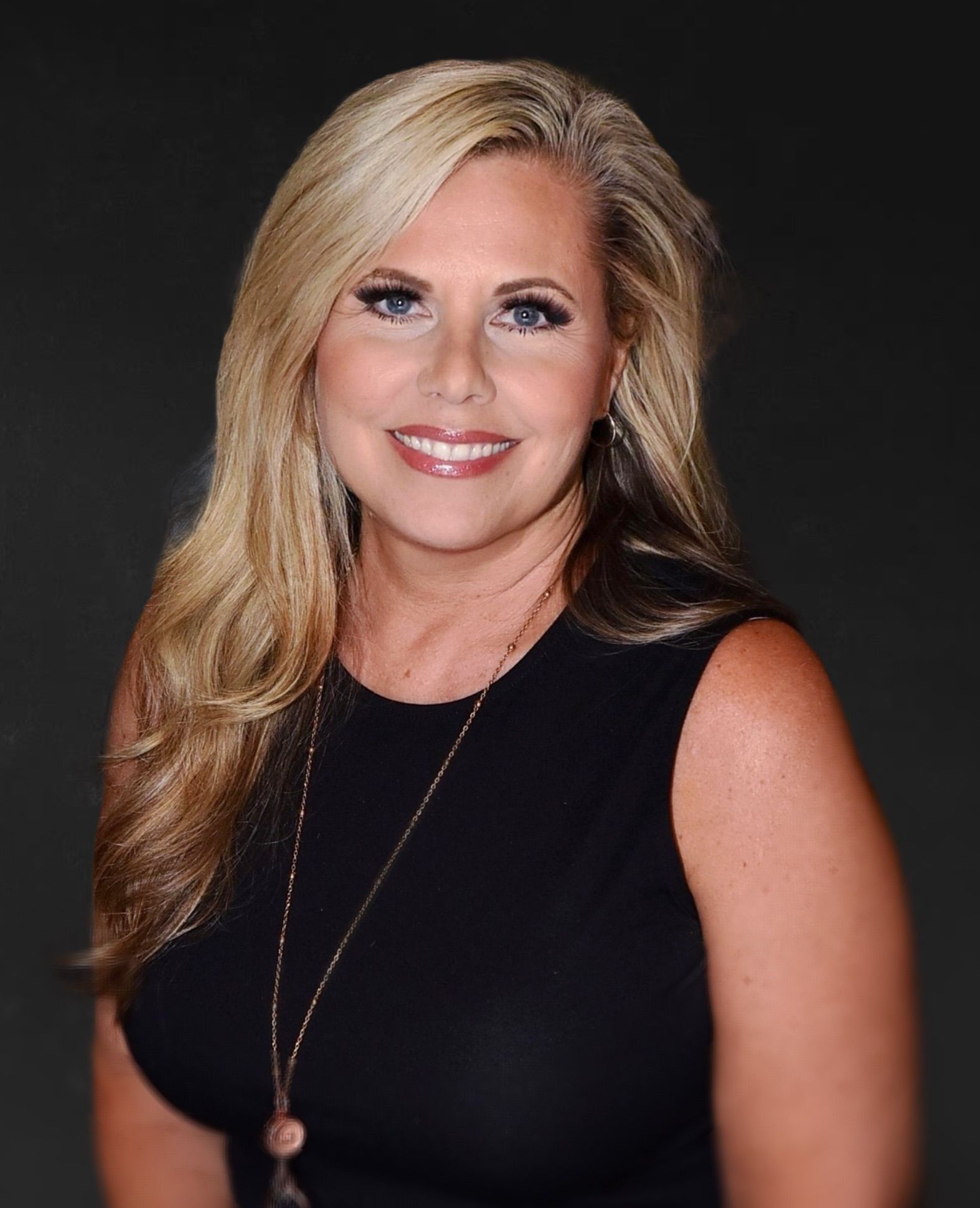
Cari McClelland. Mortgage professional.

I'm here to help you discover the perfect mortgage solution for your needs!
GET STARTED

Cari McClelland

With over a decade of experience in human resources, Cari has developed a keen understanding of people and their needs. After a successful career dedicated to talent acquisition, employee relations, training and organizational development, Cari made the exciting transition to mortgage brokering.


Driven by a passion for helping others achieve their dreams of homeownership, Cari leverages their extensive background in HR to provide exceptional customer service and personalized financial solutions. Known for her strong communication skills and empathetic approach, she excels at guiding clients through the mortgage process with clarity and confidence.


Cari holds a certificate in Human Resources Leadership and is a licensed Sub Mortgage Broker. In her spare time, she enjoys exploring local neighborhoods, volunteering in community initiatives, and staying up to date with industry trends. Whether you’re a first-time buyer or looking to refinance, Cari is dedicated to making your mortgage experience seamless and rewarding.

Happy Clients

" Our heartfelt thanks for all you did over the past month to support our mortgage search. Your integrity and professionalism are evident Cari! We will pass your name with highest recommendation and gratitude. "

Finding the best mortgage can be frustrating. It doesn't have to be when you follow my 3 step plan.

Start your journey today

The best way to begin is by reaching out to me directly. I'm dedicated to understanding your needs, evaluating your financial situation, offering expert mortgage advice, and supporting you throughout the entire mortgage process.

Gain clarity

Navigating through various mortgage lenders, rates, terms, and features can be overwhelming. Let me simplify things for you. I’ll present the best mortgage options tailored to your needs, helping you make an informed decision.

Move forward with confidence

My goal is to ensure you're always fully informed. From your initial application to your mortgage renewal, I'm here to answer any questions and support you every step of the way. You can count on me to have your back.

Get started by completing my online mortgage application.

APPLY NOW

I'll let you know exactly where you stand so you can proceed with confidence.

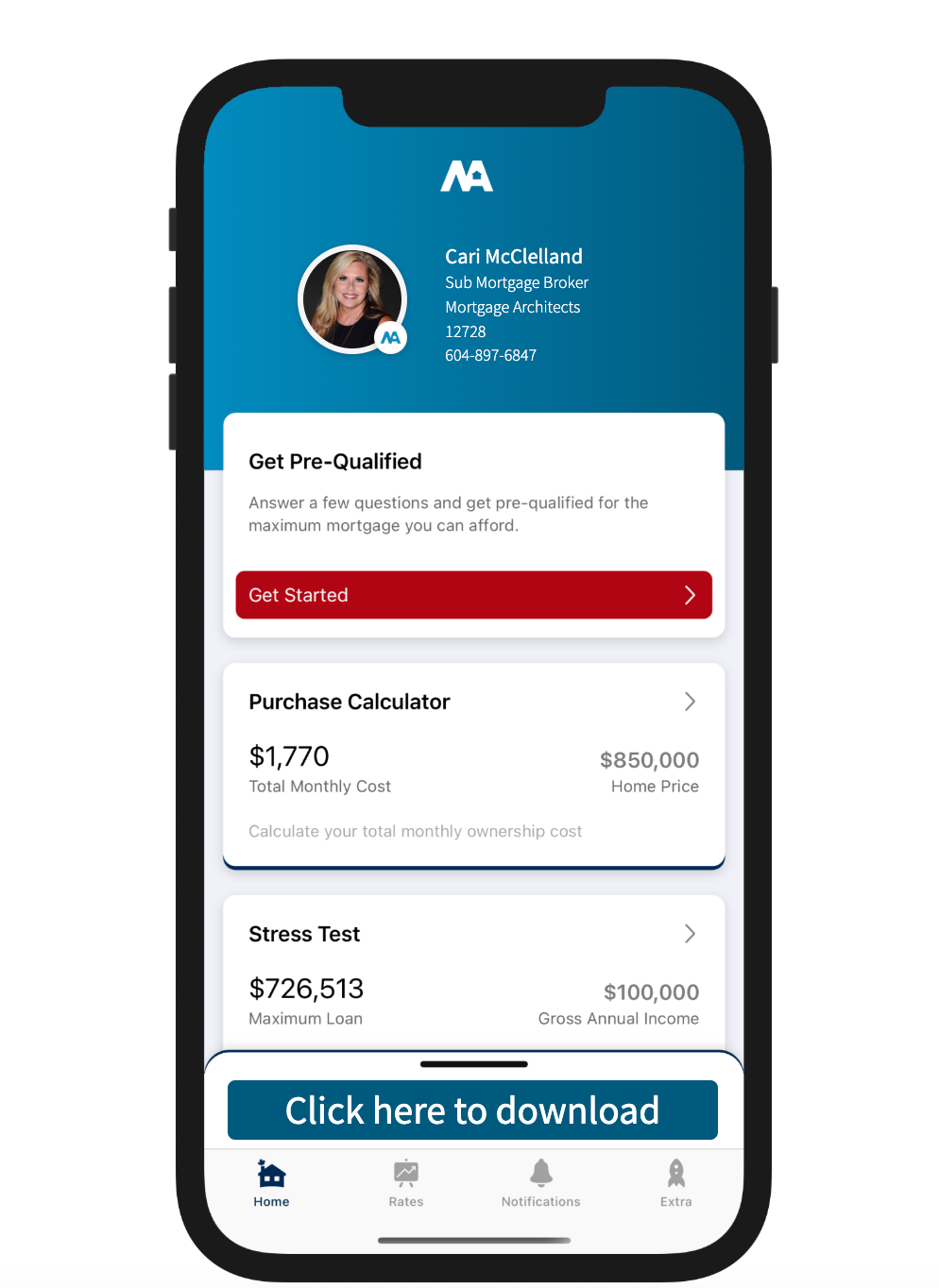
A mortgage app like no other!

What can you do with my app?


  • Calculate your total cost of owning a home
  • Estimate the minimum down payment you need
  • Calculate Land transfer taxes and the available rebates
  • Calculate the maximum loan you can borrow
  • Stress test your mortgage
  • Estimate your Closing costs
  • Compare your options side by side
  • Search for the best mortgage rates
  • Email Summary reports (PDF)
  • Use my app in English, French, Spanish, Hindi and Chinese
DOWNLOAD APP

Let's Run Some Numbers

Mortgage articles to keep you informed.

By Cari McClelland July 15, 2026
The Bank of Canada announced today that it is holding its target for the overnight rate at 2.25%, with the Bank Rate at 2.5% and the deposit rate at 2.20%. The tone of today's announcement is notably more optimistic than previous months. Here's what's changed and what it means for you.
By Cari McClelland July 8, 2026
Ready to Buy Your First Home? Here’s How to Know for Sure Buying your first home is exciting—but it’s also a major financial decision. So how can you tell if you’re truly ready to take that leap into homeownership? Whether you’re confident or still unsure, these four signs are solid indicators that you’re on the right path: 1. You’ve Got Your Down Payment and Closing Costs in Place To purchase a home in Canada, you’ll need at least 5% of the purchase price as a down payment. In addition, plan for around 1.5% to 2% of the home’s value to cover closing costs like legal fees, insurance, and adjustments. If you’ve managed to save this on your own, that’s a great sign of financial discipline. If you're receiving help from a family member through a gifted down payment , that works too—as long as the paperwork is in order. Either way, having these funds ready shows you’re prepared for the upfront costs of homeownership. 2. Your Credit Profile Tells a Good Story Lenders want to know how you manage debt. Before they approve you for a mortgage, they’ll review your credit history. What they typically like to see: At least two active credit accounts (trade lines) , like a credit card or loan Each with a minimum limit of $2,000 Open and active for at least 2 years Even if your credit isn’t perfect, don’t panic. There may still be options, such as using a co-signer or working on a credit improvement plan with a mortgage expert. 3. Your Income Can Support Homeownership—Comfortably A steady income is essential, but not all income is treated equally. If you’re full-time and past probation , you’re in a strong position. If you’re self-employed, on contract, or rely on variable income like tips or commissions, you’ll generally need a two-year history to qualify. A general rule: housing costs (mortgage, taxes, utilities) should stay under 35% of your gross monthly income . That leaves plenty of room for other living expenses, savings, and—yes—some fun too. 4. You’ve Talked to a Mortgage Professional Let’s be real—there’s a lot of info out there about buying a home. Google searches and TikToks can only take you so far. If you're serious about buying, speaking with a mortgage professional is the most effective next step. Why? Because you'll: Get pre-approved (and know what price range you're working with) Understand your loan options and the qualification process Build a game plan that suits your timeline and financial goals The Bottom Line: Being “ready” to buy a home isn’t just about how much you want it—it’s about being financially prepared, credit-ready, and backed by expert advice. If you’re thinking about homeownership, let’s chat. I’d love to help you understand your options, crunch the numbers, and build a plan that gets you confidently across the finish line—keys in hand.
By Cari McClelland July 1, 2026
Why the Cheapest Mortgage Isn’t Always the Smartest Move Some things are fine to buy on the cheap. Generic cereal? Sure. Basic airline seat? No problem. A car with roll-down windows? If it gets you where you're going, great. But when it comes to choosing a mortgage? That’s not the time to cut corners. A “no-frills” mortgage might sound appealing with its rock-bottom interest rate, but what’s stripped away to get you that rate can end up costing you far more in the long run. These mortgages often come with severe limitations—restrictions that could hit your wallet hard if life throws you a curveball. Let’s break it down. A typical no-frills mortgage might offer a slightly lower interest rate—maybe 0.10% to 0.20% less. That could save you a few hundred dollars over a few years. But that small upfront saving comes at the cost of flexibility: Breaking your mortgage early? Expect a massive penalty. Want to make extra payments? Often not allowed—or severely restricted. Need to move and take your mortgage with you? Not likely. Thinking about refinancing? Good luck doing that without a financial hit. Most people don’t plan on breaking their mortgage early—but roughly two-thirds of Canadians do, often due to job changes, separations, relocations, or expanding families. That’s why flexibility matters. So why do lenders even offer no-frills mortgages? Because they know the stats. And they know many borrowers chase the lowest rate without asking what’s behind it. Some banks count on that. Their job is to maximize profits. Ours? To help you make an informed, strategic choice. As independent mortgage professionals, we work for you—not a single lender. That means we can compare multiple products from various financial institutions to find the one that actually suits your goals and protects your long-term financial health. Bottom line: Don’t let a shiny low rate distract you from what really matters. A mortgage should fit your life—not the other way around. Have questions? Want to look at your options? I’d be happy to help. Let’s chat.
By Cari McClelland July 15, 2026
The Bank of Canada announced today that it is holding its target for the overnight rate at 2.25%, with the Bank Rate at 2.5% and the deposit rate at 2.20%. The tone of today's announcement is notably more optimistic than previous months. Here's what's changed and what it means for you.
By Cari McClelland July 8, 2026
Ready to Buy Your First Home? Here’s How to Know for Sure Buying your first home is exciting—but it’s also a major financial decision. So how can you tell if you’re truly ready to take that leap into homeownership? Whether you’re confident or still unsure, these four signs are solid indicators that you’re on the right path: 1. You’ve Got Your Down Payment and Closing Costs in Place To purchase a home in Canada, you’ll need at least 5% of the purchase price as a down payment. In addition, plan for around 1.5% to 2% of the home’s value to cover closing costs like legal fees, insurance, and adjustments. If you’ve managed to save this on your own, that’s a great sign of financial discipline. If you're receiving help from a family member through a gifted down payment , that works too—as long as the paperwork is in order. Either way, having these funds ready shows you’re prepared for the upfront costs of homeownership. 2. Your Credit Profile Tells a Good Story Lenders want to know how you manage debt. Before they approve you for a mortgage, they’ll review your credit history. What they typically like to see: At least two active credit accounts (trade lines) , like a credit card or loan Each with a minimum limit of $2,000 Open and active for at least 2 years Even if your credit isn’t perfect, don’t panic. There may still be options, such as using a co-signer or working on a credit improvement plan with a mortgage expert. 3. Your Income Can Support Homeownership—Comfortably A steady income is essential, but not all income is treated equally. If you’re full-time and past probation , you’re in a strong position. If you’re self-employed, on contract, or rely on variable income like tips or commissions, you’ll generally need a two-year history to qualify. A general rule: housing costs (mortgage, taxes, utilities) should stay under 35% of your gross monthly income . That leaves plenty of room for other living expenses, savings, and—yes—some fun too. 4. You’ve Talked to a Mortgage Professional Let’s be real—there’s a lot of info out there about buying a home. Google searches and TikToks can only take you so far. If you're serious about buying, speaking with a mortgage professional is the most effective next step. Why? Because you'll: Get pre-approved (and know what price range you're working with) Understand your loan options and the qualification process Build a game plan that suits your timeline and financial goals The Bottom Line: Being “ready” to buy a home isn’t just about how much you want it—it’s about being financially prepared, credit-ready, and backed by expert advice. If you’re thinking about homeownership, let’s chat. I’d love to help you understand your options, crunch the numbers, and build a plan that gets you confidently across the finish line—keys in hand.
By Cari McClelland July 1, 2026
Why the Cheapest Mortgage Isn’t Always the Smartest Move Some things are fine to buy on the cheap. Generic cereal? Sure. Basic airline seat? No problem. A car with roll-down windows? If it gets you where you're going, great. But when it comes to choosing a mortgage? That’s not the time to cut corners. A “no-frills” mortgage might sound appealing with its rock-bottom interest rate, but what’s stripped away to get you that rate can end up costing you far more in the long run. These mortgages often come with severe limitations—restrictions that could hit your wallet hard if life throws you a curveball. Let’s break it down. A typical no-frills mortgage might offer a slightly lower interest rate—maybe 0.10% to 0.20% less. That could save you a few hundred dollars over a few years. But that small upfront saving comes at the cost of flexibility: Breaking your mortgage early? Expect a massive penalty. Want to make extra payments? Often not allowed—or severely restricted. Need to move and take your mortgage with you? Not likely. Thinking about refinancing? Good luck doing that without a financial hit. Most people don’t plan on breaking their mortgage early—but roughly two-thirds of Canadians do, often due to job changes, separations, relocations, or expanding families. That’s why flexibility matters. So why do lenders even offer no-frills mortgages? Because they know the stats. And they know many borrowers chase the lowest rate without asking what’s behind it. Some banks count on that. Their job is to maximize profits. Ours? To help you make an informed, strategic choice. As independent mortgage professionals, we work for you—not a single lender. That means we can compare multiple products from various financial institutions to find the one that actually suits your goals and protects your long-term financial health. Bottom line: Don’t let a shiny low rate distract you from what really matters. A mortgage should fit your life—not the other way around. Have questions? Want to look at your options? I’d be happy to help. Let’s chat.